Choose
Pick your race, spot the signals other people scroll past, and talk to the people who have the problem. Five questions tell you if it's worth your time, and one more asks whether it gives you energy.
You can build something in a weekend now, and every new model makes it faster. Getting people to care is the hard part, and this book makes it easier, especially if it’s your first time. It shows you how to find a problem worth your time, prove people want it, and launch something they actually use.
For anyone building with AI next to a day job who has more ideas than weeks, or who already launched one and heard nothing.
Get the introduction and chapter one now, and a heads-up before the $2.99 launch price goes up.
Book updates only, and only when something has actually happened. Unsubscribe anytime.
Already convinced? Pre-order for $2.99The whole chapter, not a teaser.
Check and click the confirmation link, or this is the only thing you get. The templates, the book news and the price heads-up all go to confirmed readers.
Nothing in a few minutes? Check your spam folder.
Want the whole book? Pre-order it for $2.99, the launch price. Out 15 October.
The better AI gets at building what you describe, the more depends on what comes first: what to build, and for whom. Fourteen short chapters, with a short exercise after each tool so your own idea goes through the method as you read. It takes the energy an idea gives you as seriously as the numbers. Alongside my own products there are stories from other builders: a taxi app in Hong Kong, a one-person game that ended up in Tesla’s cars, a YouTube network that reached real ad revenue within months, and a Mac utility that has sold for over twenty years.
Pick your race, spot the signals other people scroll past, and talk to the people who have the problem. Five questions tell you if it's worth your time, and one more asks whether it gives you energy.
Compress what you learned into a one-page concept, a price with a reason behind it, words a stranger understands in ten seconds, and a look that earns trust before anyone clicks.
Plan together with AI, build the first version in a focused sprint, launch without an audience, and read what happened: kill, redirect, or double down.
Keep it going: where your hours actually go, how you keep your energy up, when to bring other people in, and how every round makes the next one easier.
I once co-founded a company that had half a million users, forty million video views a month, and eight hundred thousand euros in annual revenue.
It failed anyway.
The code worked. The code was never the problem.
 Oskar Glauser
From the introduction, free with chapter one
Oskar Glauser
From the introduction, free with chapter one
I never got bored, the tone feels right, and there’s a lot to take with you. The summaries at the end of each chapter are something I’ll actually go back to when I’m building.
Finished the book. It’s really good! It covers things I would never have thought about, so I definitely learned something.
So far much better than I expected, haha. Easy to follow your thinking because there’s a clear thread, and there’s been something new all the time. Books like this often get a bit repetitive, but that hasn’t happened here.
“Do you have an edge?” I love that question. I use the same one when I look over my investments, and what you invest your time in might be the most important investment you make.
Kindle ebook · 15 October
$2.99
$9.99
launch price until 22 October
Read it in a weekend
It stays $2.99 through launch week, then goes up to $9.99. Pre-order now and you keep the lower price.
Amazon charges on release day, not today. It lands on your Kindle the morning it comes out.
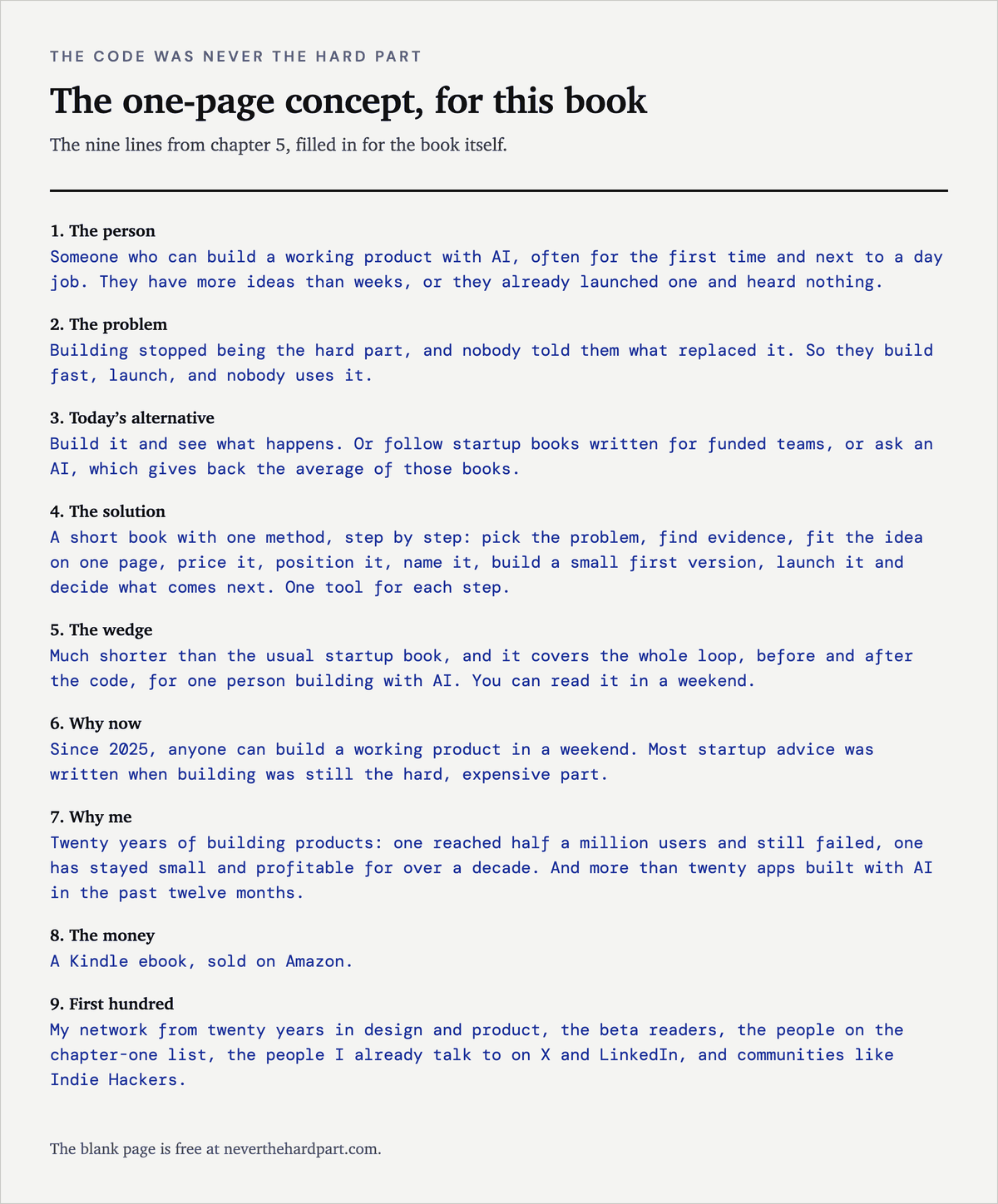
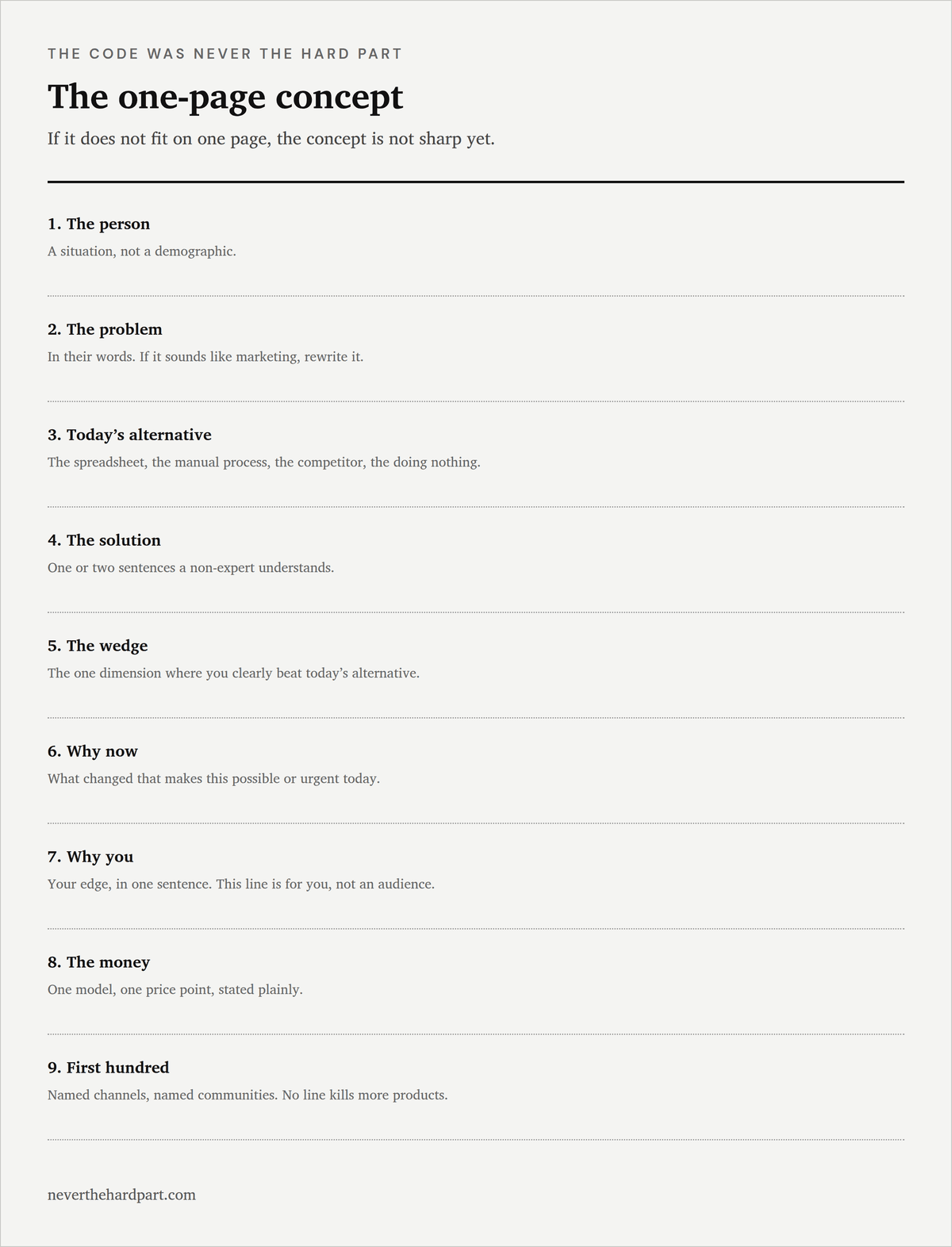
Chapter 5 asks you to fit your idea on one page, in nine lines. Here are the nine lines for this book.
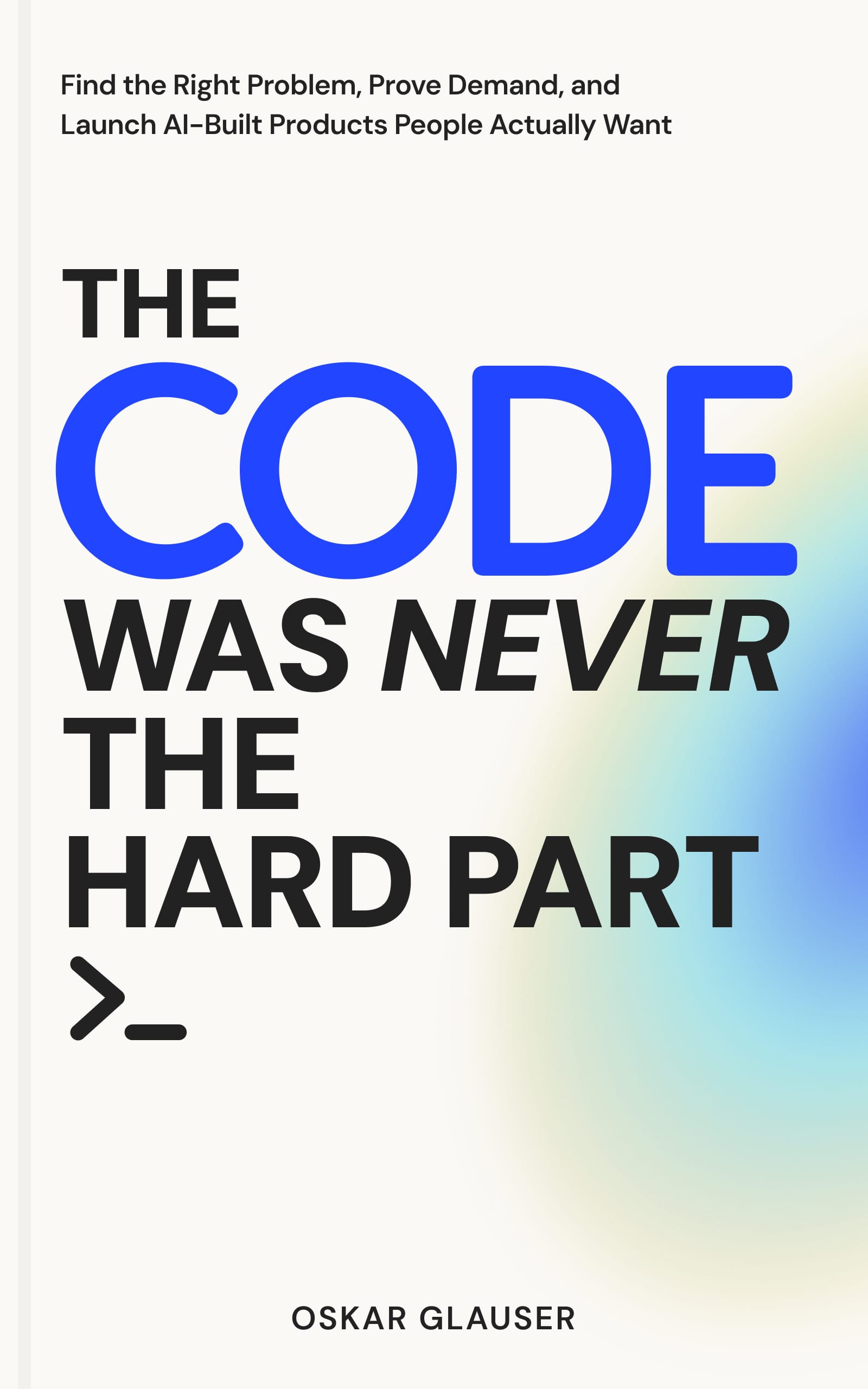
The Code Was Never the Hard Part
Someone who can build a working product with AI, often for the first time and next to a day job. They have more ideas than weeks, or they already launched one and heard nothing.
Building stopped being the hard part, and nobody told them what replaced it. So they build fast, launch, and nobody uses it.
Build it and see what happens. Or follow startup books written for funded teams, or ask an AI, which gives back the average of those books.
A short book with one method, step by step: pick the problem, find evidence, fit the idea on one page, price it, position it, name it, build a small first version, launch it and decide what comes next. One tool for each step.
Much shorter than the usual startup book, and it covers the whole loop, before and after the code, for one person building with AI. You can read it in a weekend.
Since 2025, anyone can build a working product in a weekend. Most startup advice was written when building was still the hard, expensive part.
Twenty years of building products: one reached half a million users and still failed, one has stayed small and profitable for over a decade. And more than twenty apps built with AI in the past twelve months.
A Kindle ebook, sold on Amazon.
My network from twenty years in design and product, the beta readers, the people on the chapter-one list, the people I already talk to on X and LinkedIn, and communities like Indie Hackers.
Want to fill in your own? Download the blank page. The method behind it starts in chapter one, free below.
Someone who can build a working product with AI, often for the first time and usually next to a day job, who has more ideas than weeks and no way yet to tell which one deserves them. It’s also for the person who already launched one, heard nothing, and can’t tell whether to fix it, push harder or move on. It’s written for people doing this for the first few times, not for veterans.
No. The book is about everything around the code: picking the problem, talking to people, pricing, positioning, launching and deciding what comes next. If you’ve tried vibe coding, you already know the building part. This book is about the part that decides whether anyone uses what you build.
Ask an AI and you get the average of every startup book ever written. What a prompt can’t give you is the order, which questions matter before which, and twenty years of my own mistakes with the numbers attached. The book was written with AI as a co-writer, with the generic parts cut.
No, it’s a book about improving your odds. There are warnings in it, because I’ve paid for most of them, but the tools are there to help you adjust your course early, while it’s still cheap. Trying has never been cheaper, and building things is fun. The book just adds some structure.
Mostly, yes. The method is about demand, not code: signals, conversations, the one-pager, price, words, name, launch and decisions. Only the build sprint assumes software, and you swap it for the smallest real thing that can produce a real signal.
No. None of the products in the book had one on day one. The first hundred users are found by hand, one message at a time, from the people you talked to and the communities you already take part in.
The book names no build tools on purpose, and the habits it teaches, like planning first and working in small steps, have survived every tool change so far. The better the models get at building, the more everything comes down to what to build, and for whom.
A Kindle ebook, out 15 October 2026. About 160 pages: fourteen short chapters and two appendices, and most chapters end with a short summary you can use as a checklist. Short enough to read in a weekend.
Building has never been cheaper, which makes this a good time to start. Chapter one is about what to build now, and it’s free.
Book updates only, and only when something has actually happened. Unsubscribe anytime.
The whole chapter, not a teaser.
Check and click the confirmation link, or this is the only thing you get. The templates, the book news and the price heads-up all go to confirmed readers.
Nothing in a few minutes? Check your spam folder.
Want the whole book? Pre-order it for $2.99, the launch price. Out 15 October.