Choose
Pick your race, spot the signals other people scroll past, and talk to the people who have the problem. Five questions tell you if it's worth your time.
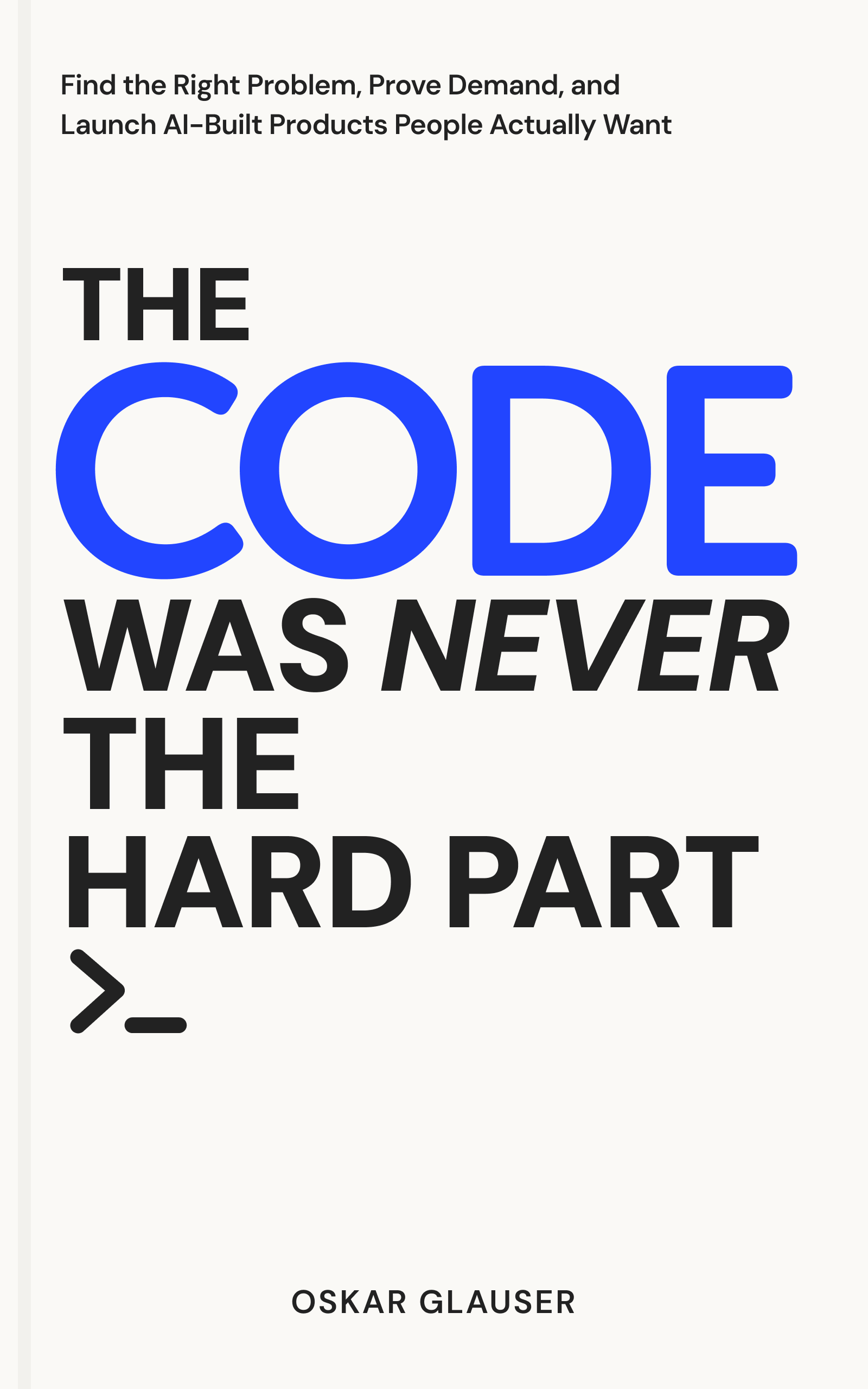
AI made building fast. Knowing what to build is still the hard part. This book shows you how to find the right problem, prove that people want it, and launch it before you've spent months on the wrong thing.
Join the early-reader list to get the opening chapter now, the templates from the book as they're finished, and a heads-up before the $2.99 launch price goes up.
Book updates only, and only when something has actually happened. Unsubscribe anytime.
Already convinced? Pre-order for $2.99 →The whole chapter, not a teaser.
Check and click the confirmation link, or this is the only thing you get. The templates, the book news and the price heads-up all go to confirmed readers.
Nothing in a few minutes? Check your spam folder.
Want the whole book? Pre-order it for $2.99, the launch price. Out 15 October.
Fourteen chapters in four parts: choose the problem, shape it into a product, ship it, and keep it running. Most of the time goes into thinking and talking to people. The build comes at the end, and then you look at what actually happened.
Pick your race, spot the signals other people scroll past, and talk to the people who have the problem. Five questions tell you if it's worth your time.
Compress what you learned into a one-page concept, a price with a reason behind it, words a stranger understands in ten seconds, and a look that earns trust before anyone clicks.
Plan together with AI, build the first version in a focused sprint, launch without an audience, and read the response honestly: kill, redirect, or double down.
Run it as a one-person company: where your hours actually go, how you keep the energy up, and how every round makes the next one easier.
I once co-founded a company that had half a million users, forty million video views a month, and eight hundred thousand euros in annual revenue.
It failed anyway.
The code worked. The code was never the problem.
The introduction comes with chapter one, free with your signup.

Kindle ebook · 15 October
$2.99 launch price
It stays $2.99 through launch week, then goes up to $9.99. Pre-order now and you keep the lower price.
Amazon charges on release day, not today. It lands on your Kindle the morning it comes out.
The cheaper building gets, the more it matters what you choose to build. Chapter one is about exactly that.
Book updates only, and only when something has actually happened. Unsubscribe anytime.
The whole chapter, not a teaser.
Check and click the confirmation link, or this is the only thing you get. The templates, the book news and the price heads-up all go to confirmed readers.
Nothing in a few minutes? Check your spam folder.
Want the whole book? Pre-order it for $2.99, the launch price. Out 15 October.