Customer interview questions
The conversation guide
Five questions for talking to people who have the problem you want to solve, and a scale for scoring what you heard. Every question asks about what people have done, not what they would do, because nobody can politely invent a detailed history. Use it before you build, for five to ten conversations per problem.
The Code Was Never the Hard Part
The conversation guide
Ask about what people have done, not what they would do. Don't pitch. Your product barely comes up, and early on it shouldn't come up at all.
-
When did you last run into this? Tell me about that time.
-
What did you do about it, step by step?
-
What have you tried before? Why did you stop?
-
What does this cost you, in time or money or stress?
-
If you could wave a wand at one part of this, which part?
Score the conversation
Weakest to strongest. Pick the highest one that really happened.
You're looking for a problem where most conversations land at three or higher. A candidate whose conversations cluster at one and two is telling you to let it go.
neverthehardpart.com/templates/conversation-guide
How to use it
- Find five to ten people per problem. Not fifty. Patterns show up early, and after seven or eight conversations you'll be hearing repeats. Look in the same places your signals came from: the communities, forums and groups where people have already described the problem in public.
- Send a short, plain message. You're researching how people handle the problem, you aren't selling anything, and you'd love twenty minutes of their experience. People enjoy being treated as experts on their own pain.
- Before any results come in, write down what counts as a yes. Something like: at least half the conversations reach three or higher, and at least one reaches five.
- Ask the five questions. Thirty minutes is enough. Stay in the past tense and don't pitch, because the moment you pitch, people start being kind instead of accurate.
- Score each conversation on the scale, then judge the problem against the numbers you wrote down.
Why the past tense
The future tense invites fantasy. "Would you pay for this?" costs nothing to answer generously. The past tense demands facts. "What do you do about this today?" "When did it last happen?" "Walk me through it." Nobody can politely invent a detailed history, so the past tense gets you truth almost by accident.
Be careful with friends. They're the least reliable sources on earth, because they're rooting for you. If you talk to friends, use the past-tense questions with extra discipline.
If nobody responds at all, treat that as data. If you can't reach the people who have this problem for a conversation, you won't reach them for a sale either.
What counts as evidence
A pull is the strongest signal a conversation can produce, because you didn't ask for it. Polite interest is worth nothing, however warm it sounds. Every candidate you drop because its conversations stay at one and two saves you the months it would have cost to learn the same thing from a launch.
Where AI fits
AI speeds up the work around the conversations: finding where your people gather, drafting outreach, preparing questions, transcribing calls, and sorting your notes for recurring pains and the exact phrases people used. What it can't do is have the conversation for you. Simulated users and AI-generated customer feedback will happily validate anything, because there's no pain behind the words. So I use AI for the questions, never for the answers.
From chapter 4, "Evidence".
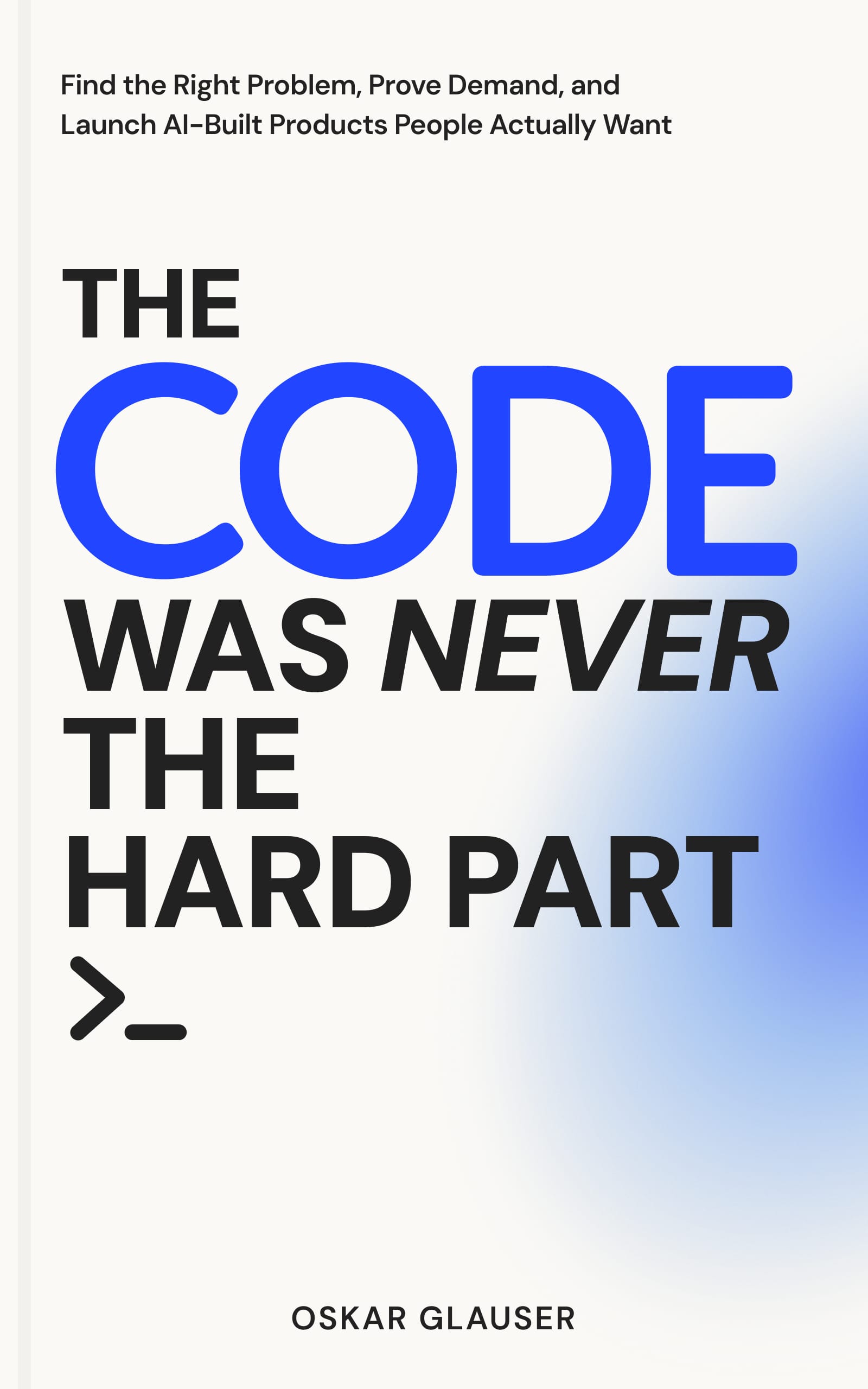
Kindle ebook · 15 October
Pre-order it now, read it on launch day.
$2.99
$9.99
launch price until 22 October
Read it in a weekend
It stays $2.99 through launch week, then goes up to $9.99. Pre-order now and you keep the lower price.
Amazon charges on release day, not today. It lands on your Kindle the morning it comes out.