How to use it
- In an AI assistant that supports skills, such as Claude, download the zip and upload it where the app manages skills or capabilities. The skill switches on when you ask for help naming something.
- In a coding agent, unzip it into the agent's skills folder, so the file ends up at
skills/naming/SKILL.md. For Claude Code that's~/.claude/skills/naming/SKILL.md. - In any other chat, copy the instructions, paste them as your first message, then describe what you're naming.
With web search turned on, the assistant runs the search and trademark checks itself and shows you the links. Without it, it gives you the exact searches to run. It's told never to call a name available or safe without having checked, and its checks are never legal advice.
What the skill does
- Ask the questions first. What it is and who it's for, where it's going, whether to stand out or blend in, how long, how much the domain matters, and which languages it must work in.
- Pick a road to memorability. Surprising or confident, and one or two naming styles that fit the answers.
- Go wide without judging. Thirty to fifty candidates grouped by style, leaving out the names AI hands to everyone.
- Cut hard, to three. Spelling by ear, pronunciation in the target languages, room to grow, and no near-copies.
- Check the finalists. Search results, trademarks in the category, domain, handles, app stores, and meanings in slang and other languages.
- Run the stranger test. Each finalist with its one-line description, shown to people who fit the audience for ten seconds.
- Decide within days. One recommendation with reasons and open risks, then stop.
Product naming best practices
These are the practices the skill follows, from chapter 8 of the book and the rules most naming work comes back to. You can use them without any AI at all.
Ask the questions before you brainstorm
Most naming pain comes from generating names first and thinking about them afterwards. Before the first idea, decide who it's for, how long the name should be, whether it should stand out from its category or blend in, and how much the exact domain matters. With those answers, a long list is quick to cut.
Short names are easier to remember and harder to own
A short real word is memorable and almost always taken somewhere. A longer name or a compound gives you room for meaning and is easier to secure. Neither is wrong, so pick the trade you can live with.
Name it for where it's going
Good products often start narrow and widen later. A name tied to one feature, one city or one trend can turn into a cage. Check each candidate against what the product might be in three years, not only what it does at launch.
Decide whether to stand out or blend in
Some categories reward a name that sounds like nobody else's. Others, like finance or health, reward a name that sounds credible next to the established players. Make that choice deliberately, and make it agree with how you position the product.
Pick a style, any style
Names stick for one of two reasons. An unexpected name sticks because it surprises. A confident, minimal name sticks because it sounds sure of itself. Between those ends sit the common styles:
- Descriptive compound. Says what it does. Minutemailer promises mail in minutes before the tagline says a word.
- Bent category word. Videofy twists the category word itself.
- Short real word. Mira is easy to say in most languages, and in Spanish it means "look".
- The customer's own term. Turntime, for a company that speeds up how fast an airplane is turned around, puts the customer's metric into two syllables.
- Blend of two words. Glamanic, a social beauty app, mixes glamour with a bit of mania.
- Invented word. Fully ownable, and it needs more explaining.
- A joke that stuck. Dayrobber came from a friend who said our short videos would rob you of your day.
No style beats the others. Descriptive names explain more and odd ones stand out more, and what you write next to the name does more work than how clever it is.
Avoid the names AI hands to everyone
Ask an AI for a name and many other people asking the same thing get the same few words back. I liked Atelier and used it for a project, and since then I've seen a lot of AI-built apps with the same name. Generate widely, then cut the first obvious words in every style.
Pass the phone test
Say the name to someone over the phone and ask them to write it down. If what they type isn't what you said, you'll lose people in every recommendation, podcast mention and spoken introduction, which are the channels a small product grows through. Silent letters, double letters, homophones, numbers and hyphens are the usual causes.
Search harder than the domain
Checking whether the domain is free is where most people stop, and it's the least of it. Search the name and its likely misspellings and look at who you'd share the first page of results with. If it's a big brand or something unpleasant, people looking for you will find them first.
Check trademarks in your category
Search the registers for the same or a confusingly similar name in your kind of goods or services. In Europe, EUIPO's eSearch and TMview are free and take minutes. In the US, use the USPTO's trademark search, and WIPO's Global Brand Database covers many countries at once. Ten minutes per finalist now beats a forced rename after launch, which is the most expensive way to learn trademark law.
The .com is nice, not necessary
For a web product the domain matters some. For an app or a physical product it matters less than founders assume, because almost nobody types domains. A clear variant with get-, try- or use- in front, or a fitting ending, works if it's easy to say.
Check handles and app stores
Look up the name on the social platforms where your audience spends time, and search the app stores for it. A crowded app store search is a bigger problem than a taken handle.
Check what else it means
Run the name through a slang dictionary and translate it into the language of every market you might reach. Honda reportedly prepared to sell a car called the Fitta in Scandinavia, a word I won't translate here, and it became the Jazz across much of the world. As a Swede, I can confirm the internet never forgot.
Test it next to its line, with strangers
Show each finalist with its one-line description to a few people who fit your audience and know nothing about the project. Give them ten seconds, take it away, and ask what it is, who it's for and what it would cost. A name that pulls the guesses into the wrong category loses to a duller name that doesn't.
Company names and product names
A company name can be broader and quieter, because it may hold more than one product over time. If you'll have one product, giving both the same name means every mention builds one thing. A founder's surname is easy to own and hard to grow beyond the founder, and initials are hard to remember until a company is already famous.
Decide within days
For more than one idea, I've let the hunt for a perfect name turn days into weeks. It isn't worth it. A name becomes what you fill it with, the way nobody hears "Apple" and thinks of fruit. If real demand turns up under a weak name, renaming is a happy problem. A perfectly named product that never shipped is the failure that hurts.
The naming checklist
- Decide audience, length, room to grow, stand out or blend in, and how much the domain matters, before brainstorming.
- Write a long list without judging, in two or three styles.
- Cut the names AI suggests to everyone and the near-copies of other brands.
- Keep three. Say each over the phone and see what gets written down.
- Search each name and its misspellings.
- Search the trademark registers in your category.
- Check the domain, the handles and the app stores.
- Check slang and every language you might sell in.
- Run the stranger test with the name and its one-line description.
- Pick one within days, and stop.
Questions about naming
How long should a product name be?
Short enough to say and spell after hearing it once. Short names are easier to remember and harder to secure, because most short words are taken. Two or three syllables is a common middle. Longer names leave more room for meaning and originality, and they're easier to own.
Do I need the .com domain?
For a web product it helps, but it isn't required. For an app or a physical product it matters less than founders assume, because few people type domains anymore. A clear variant such as get-, try- or use- in front, or -app after, is fine as long as it's easy to say out loud.
How do I check if a name is already trademarked?
Search the trademark registers for the same or a confusingly similar name in your own category of goods or services. EUIPO's eSearch and TMview cover Europe, the USPTO's trademark search covers the US, and WIPO's Global Brand Database gives a wider sweep. They're free and take minutes. A clash outside your category is usually less of a problem than one inside it, and for anything serious a trademark lawyer has the last word.
Can AI come up with a good name?
AI is good at the long list, because it produces volume quickly, and you add the taste. Its weakness is that the same request gives many people the same few names, so AI-suggested names are often already crowded. Ask it for many options across different styles, cut the obvious ones, and run the same checks on whatever it suggests.
Should the company and the product have the same name?
If you plan one product, using the same name is simpler and every mention builds one thing. If you expect several products, the company name can be broader and quieter, and each product can carry its own name. Decide early which of the two you're building, so the names follow one style.
Is it too late to rename after launch?
Rarely. If real demand turns up under a weak name, changing it is some paperwork on top of a working business. Renaming hurts most when it's forced by a trademark conflict, which is what the checks before launch are for.
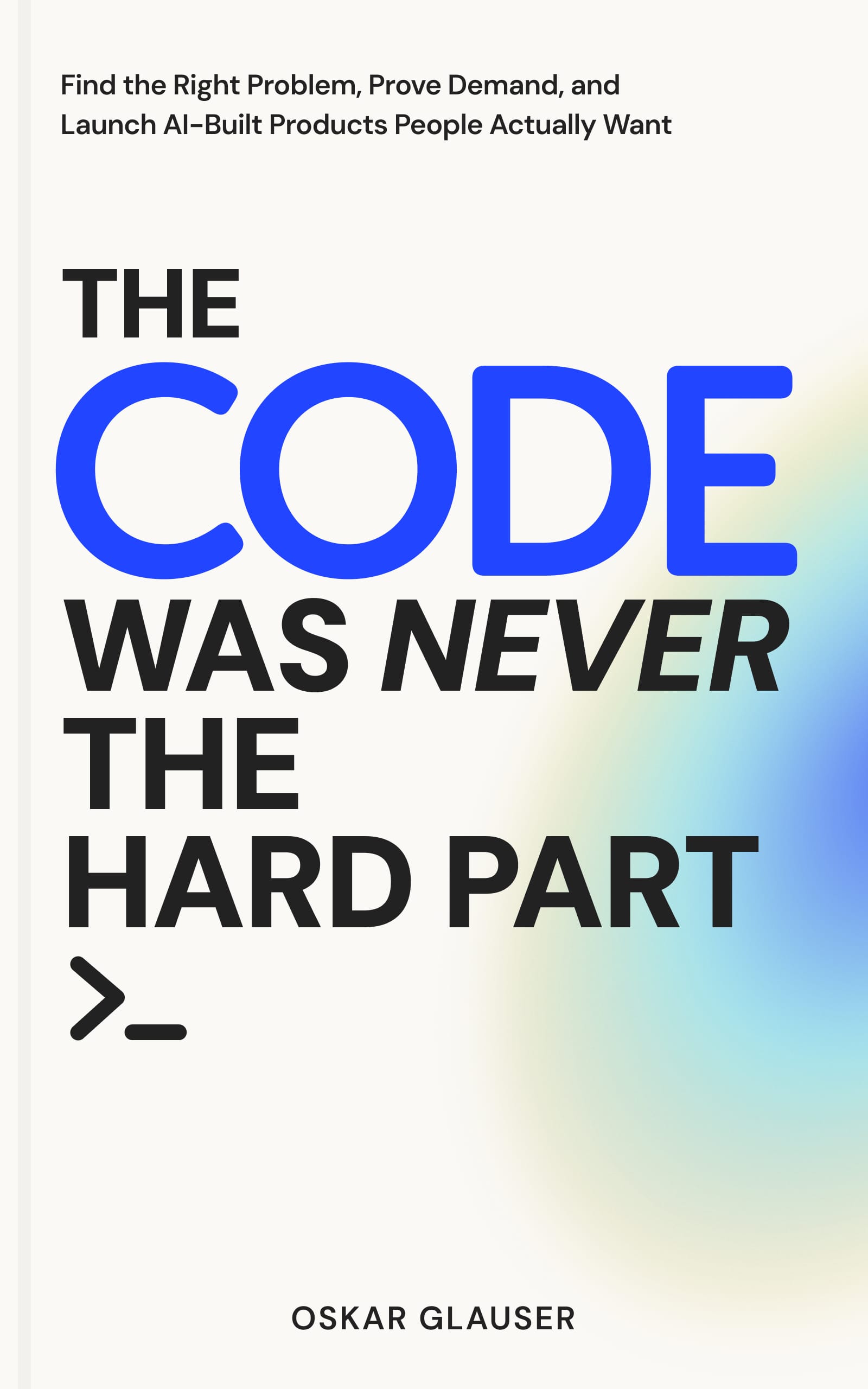
Based on chapter 8, "The name", and the stranger test from chapter 7, "Positioning", of The Code Was Never the Hard Part.