One-page business plan template
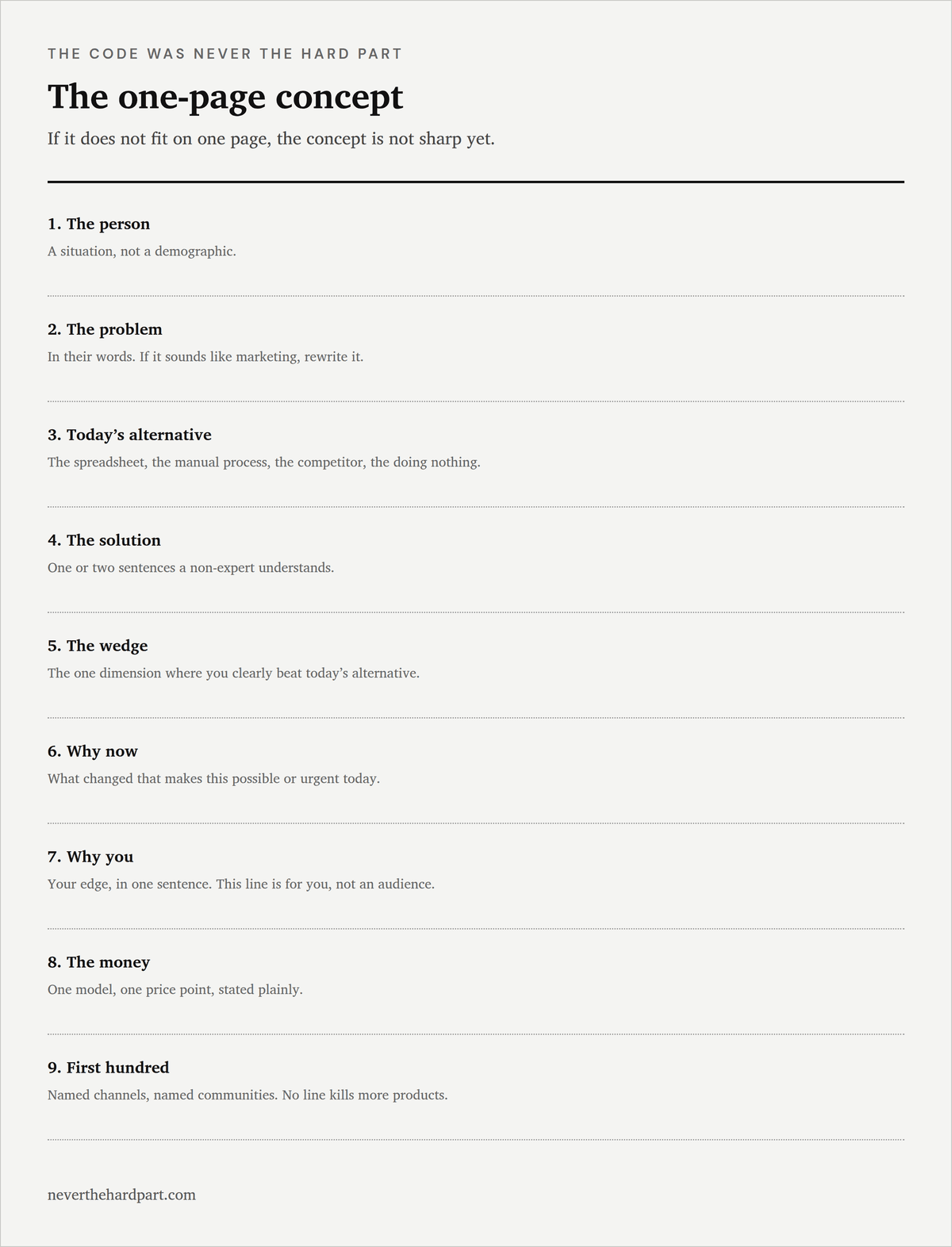
The one-page concept
Nine lines that fit your whole idea on one page: who it's for, what it does, why it wins, and how the money works. It's the cheapest prototype you'll ever build, because it tests the business instead of the product. Fill it in after your customer conversations and before you write any code.
The Code Was Never the Hard Part
The one-page concept
If it doesn't fit on one page, the concept isn't sharp yet. One to three sentences per line.
-
The person
A situation, not a demographic.
-
The problem
In their words. If it sounds like marketing, rewrite it.
-
Today's alternative
The spreadsheet, the manual process, the competitor, the doing nothing.
-
The solution
One or two sentences a non-expert understands.
-
The wedge
The one dimension where you clearly beat today's alternative.
-
Why now
What changed that makes this possible or urgent today.
-
Why you
Your edge, in one sentence. This line is for you, not an audience.
-
The money
One model, one price point, stated plainly.
-
First hundred
Named channels, named communities. No line kills more products.
The napkin business case
Realistic means counting from the bottom: the people you can reach through line nine, and the share that might convert.
Price
Realistic customers, year one
Revenue
Assumptions, worst damage first
What must be true for this to work. The top two or three decide what your first version must test.
Reread it cold after a day. Would the people from your research nod at lines one to three? Would a stranger understand lines four and five without you explaining? Do you actually believe line nine?
neverthehardpart.com/templates/one-page-concept
How to use it
- Fill it in after your customer conversations, with your notes and the exact phrases people used at hand.
- Write each line in one to three sentences, no more. If you can't fill a line, you've found a gap in your knowledge while it's still cheap to fill.
- Under the nine lines, do the napkin math: price times realistic customers in year one. Then look at that revenue next to the race you picked. Forty customers at fifteen a month is roughly seven thousand a year, which is fine for a side product and a disaster for a venture you plan to live on.
- List the assumptions that must be true for this to work, and rank them by how much damage each would cause if wrong.
- Write your launch thresholds now, while you have nothing to defend.
- Put the page away for a day, then reread it cold with the three questions at the foot of the sheet. If the answers are yes, print it and keep it visible. Mid-build, when tempting features appear, it's the page you check. Is this on the page? No? Then not now.
The nine lines
1. The person
Who exactly is this for? Not a demographic, a situation. "Freelance designers juggling client feedback across email and chat" beats "creatives" by a mile. Use the actual people from your research as the picture in your mind.
2. The problem
In their words, not yours. You collected exact phrases in your conversations. Use them. If your problem statement sounds like marketing, rewrite it until it sounds like a complaint you overheard.
3. Today's alternative
What do they do right now? The spreadsheet, the manual process, the competitor, the doing nothing. Your real competition is usually the current habit rather than another product, and habits are strong.
4. The solution
What you'll build, in one or two sentences a non-expert understands. A test I use: what is the one question the product answers, and how fast? For an energy app I worked on, the question was "when should I use electricity to save money", and the answer had to be a graph you read as green or red in three seconds.
5. The wedge
Why will they switch? Name the one dimension where you clearly beat today's alternative: dramatically faster, dramatically simpler, dramatically cheaper, or possible-at-all. Products that are slightly better at five things lose to products that are dramatically better at one.
6. Why now
What changed that makes this possible or urgent today? A new technology, a new behavior, a new rule. If nothing changed, ask yourself why this doesn't already exist.
7. Why you
Your edge, in one sentence. Reach, knowledge, credibility, taste. Don't flatter yourself here. This line is for you, not for an audience.
8. The money
How does revenue happen? One model, one price point, stated plainly. Subscription at X per month. One-time purchase at Y. Take a position. You'll adjust later, but "we'll figure out monetization" isn't a line.
9. First hundred
Where specifically do the first hundred users come from? Named channels, named communities, your list from the research phase. If this line is weak, stop and fix it before building anything, because no line on this page kills more products than this one.
A filled page, for real
This is the page for Mira, a customer-interview tool I built. Line eight is unfinished, and the page says so. It doesn't need to be impressive, only true.
- 1. The person
- Founders and product teams who make decisions without talking to users, because proper interviews take too long to arrange and run.
- 2. The problem
- “We did some interviews last quarter.” “The NPS is trending down.” Decisions made on stale conversations or shallow numbers.
- 3. Today's alternative
- Surveys nobody answers thoughtfully, an NPS dashboard, or a quarterly interview round that is outdated on arrival.
- 4. The solution
- An AI interviewer that has natural conversations with your users, at any hour and in their language, and synthesizes what it hears into patterns.
- 5. The wedge
- Interview depth at survey scale. Possible-at-all.
- 6. Why now
- Conversational AI just crossed the line where a machine-led interview is one a human will happily finish.
- 7. Why me
- Twenty years of doing this research by hand for companies, and I am my own first user.
- 8. The money
- Subscription. Exact price still being tested.
- 9. First hundred
- My consulting network, the users of my other product, and the product and research communities I already belong to.
And here are the nine lines for the book itself, run through its own method.
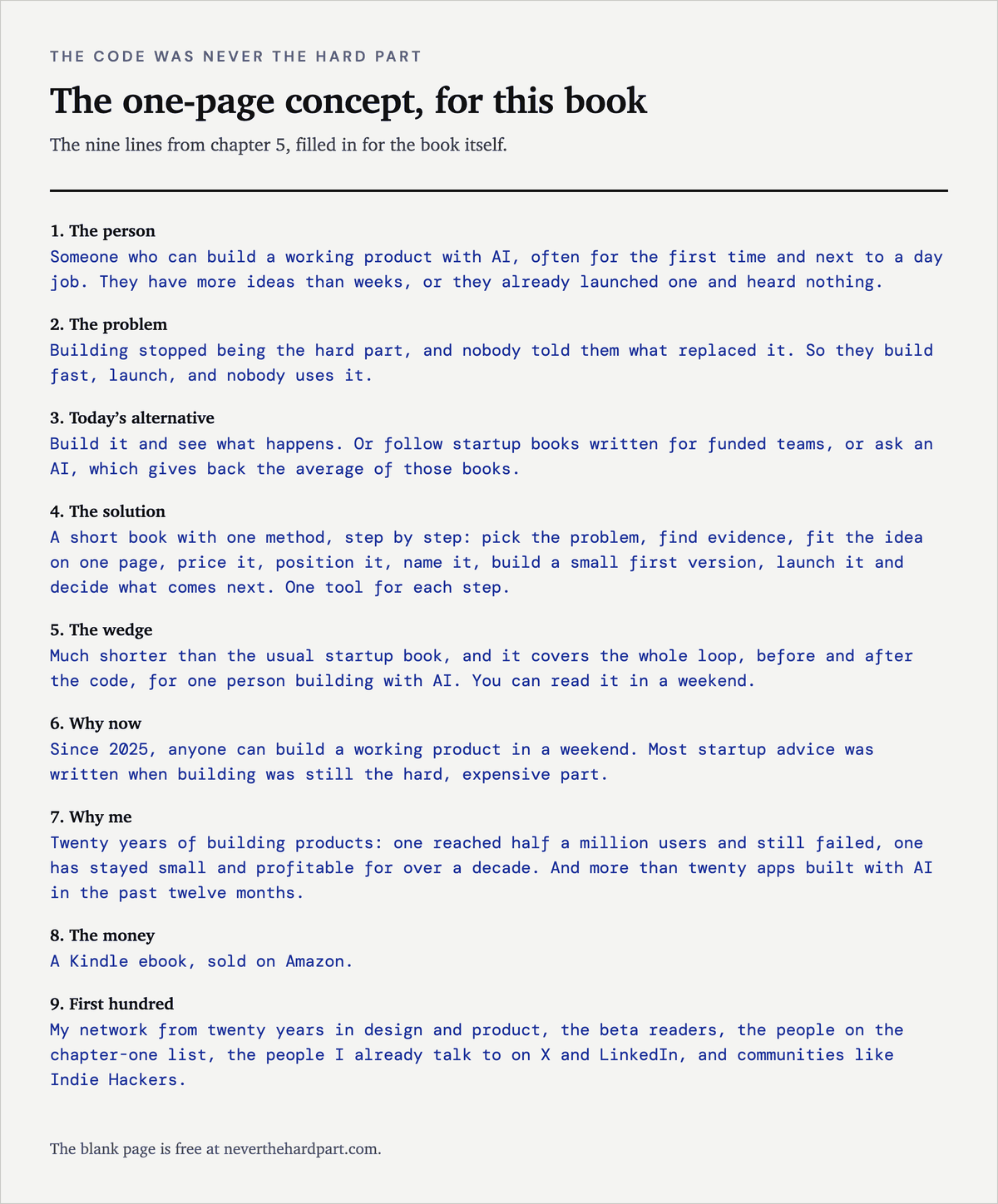
From chapter 5, "The one-page concept".
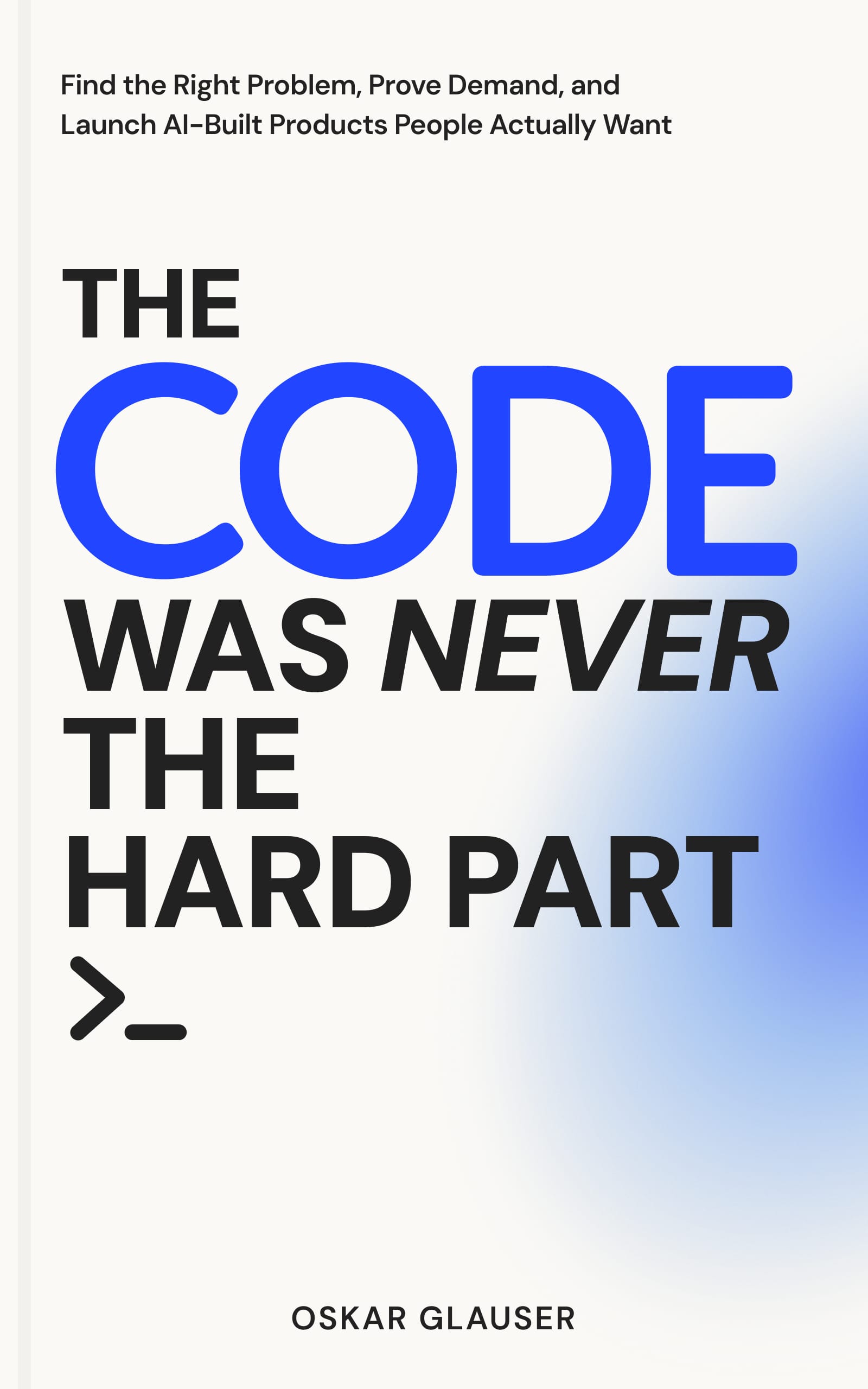
Kindle ebook · 15 October
Pre-order it now, read it on launch day.
$2.99
$9.99
launch price until 22 October
Read it in a weekend
It stays $2.99 through launch week, then goes up to $9.99. Pre-order now and you keep the lower price.
Amazon charges on release day, not today. It lands on your Kindle the morning it comes out.