Pricing
What should you charge?
Your costs are invisible to the customer and nearly irrelevant to the price. What the problem already costs people is what you price against. Pick the model from how often the problem comes back, then the number from the pain.
1 · The model
How does the problem come back?
Let how often the pain comes back pick the model. Get it wrong and it's built into everything and expensive to change. Almost everything else about pricing is easy to adjust later.
How often do people run into it?
Does every use cost you real money, like AI compute?
Your model
2 · The number
What does the problem cost them today?
That's today's alternative, line three of your one-page concept, and it already has a price. Fill in what applies, per month, for one customer.
Price it around
- The problem costs
- Low end
- High end
Say it out loud. It should sound fair.
3 · The check
Hold your own number up to it
A stranger who can't judge your product yet can judge your price instantly. They read it the way they read your typography, as a signal of what this is and whether to trust it.
Against the pain
Why the pain, not your costs
If your product saves a business five hours a month, a price that costs them one is easy arithmetic in your favor, whatever your hosting bill says. The suggestion above uses about a fifth of what the problem costs today, the same ratio as that example, rounded to a number you can say without apologizing.
Almost every first-time builder prices too low out of modesty, and modesty isn't how the customer hears it. A low price also makes people doubt you. They wonder if the product is thin, if support will answer, and if the company will still be around next year. When people have a problem that hurts, they rarely go looking for the cheapest fix. They buy the one that seems most likely to solve it, at a price that makes sense next to the pain.
Test the price like everything else
- Put it on the page. Your throwaway test page becomes a sharper instrument the moment a price appears on it, because a hand raised next to a visible price is worth five raised next to the word "free." If sign-ups collapse when the price appears, you've just done the cheapest pricing research there is.
- Charge from the beginning, at least for something, if payment is one of your risky assumptions. Nothing else people say means as much as what they pay. A free launch just puts that question off.
- Revisit at double-down. If people come back and ask for more, the price earns a test upward. Raise for new customers, keep your early users on what they signed up for, and tell them so.
Krzysztof, who makes the Mac utility Cocktail, started at about ten dollars more than twenty years ago. In 2026, a single license was nineteen. He had tried twenty-four instead of nineteen once, and it changed things so much that he went back.
From chapter 6, "What to charge".
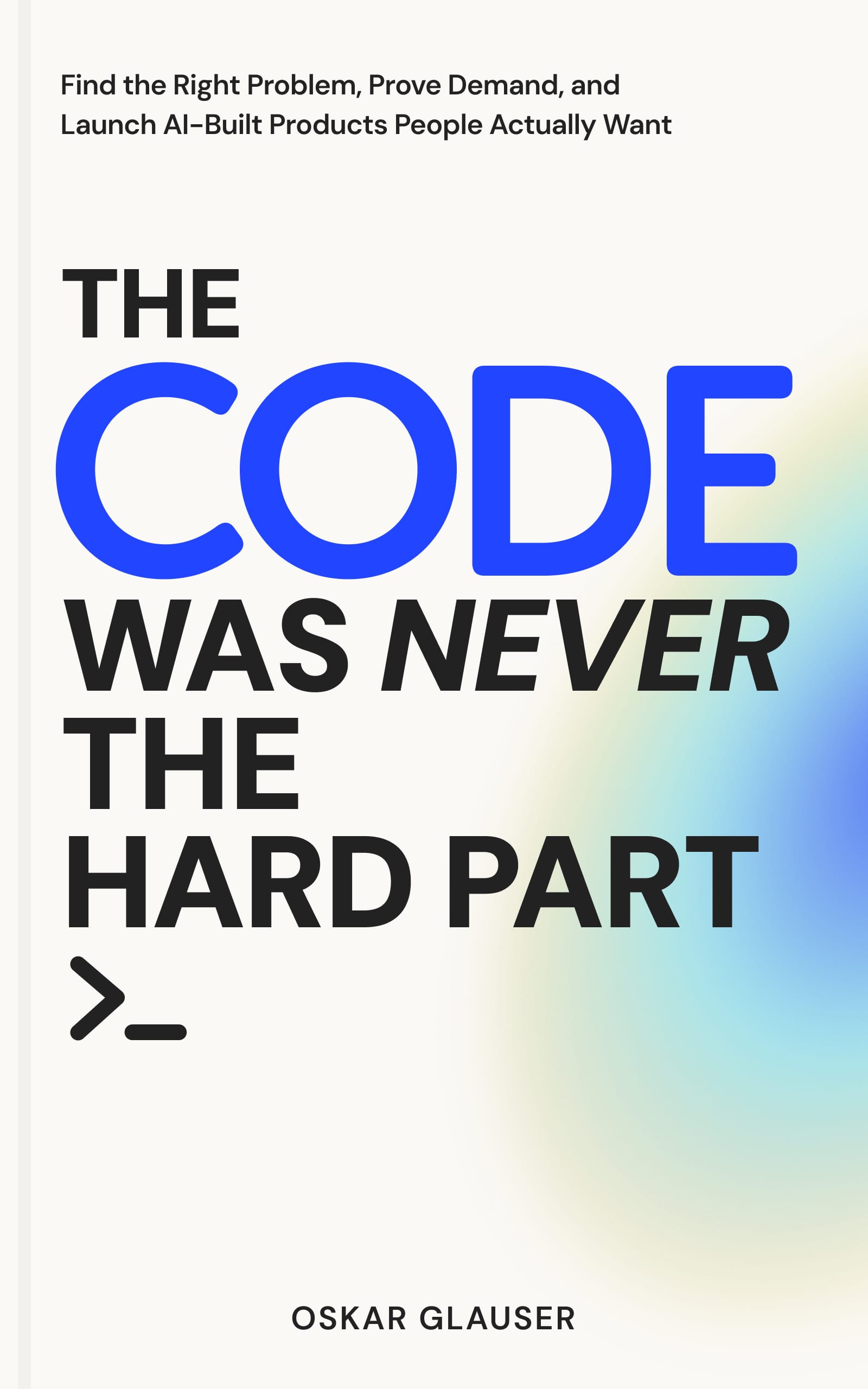
Kindle ebook · Out now
Out now. Read it this weekend.
$2.99
$9.99
launch price until 22 October
It stays $2.99 through launch week, then goes up to $9.99.
Read it on a Kindle or in the free Kindle app on your phone, tablet or computer. The paperback comes later.