Napkin math
How many yeses do you need?
Price times realistic customers equals revenue. Put in your price and how many people you can actually reach, and see what your idea turns into: a hobby, a holiday or a salary.
Your numbers
How many customers do you need?
Not the market size, and not one percent of some giant number. The people you can reach in year one, and the share of them who might pay.
Your napkin says
- Paying customers
- Revenue a year
- Revenue a month
Revenue before costs and tax, as if every customer paid all year. Treat it as the best case for year one. It's a ten-minute sanity check, not a financial model.
Every goal
What each goal takes at your price
| Goal | Yeses | People to reach |
|---|
Same goal, different price
What the price does to the work
The same goal can need hundreds of customers or a few dozen. If your reach is small, the price has to do more of the work.
| Price | Yeses | People to reach |
|---|
How to count realistic customers
- Start from your channels, not from the market. The people you've interviewed, your own network, the communities where you already take part, anyone on a list you run. That's line nine of the one-page concept.
- Then guess the share who pay. For people you've talked to about the problem, it can be much higher than for strangers landing on a page. With no idea at all, start at two percent and change it when you have data.
- Round down. Realistic means counting from the bottom, not taking one percent of some giant market. It's a ten-minute sanity check, and it can spare you building something whose numbers never worked.
The price sets how many yeses you need
Forty customers at fifteen a month is roughly seven thousand a year. That's fine for a side product and a disaster for a venture you plan to live on. The product and the effort are the same. Your race decides the verdict.
At nine dollars a month, a living wage needs hundreds of customers flowing through the channels on line nine. At ninety dollars, it needs a few dozen, for the same effort.
If the number above looks thin, you have three levers: more reach, a higher share who pay, or a higher price aimed at a sharper pain for a narrower customer. The last one is usually the cheapest to test. Find a price you can defend.
From chapter 5, "The one-page concept", and chapter 6, "What to charge".
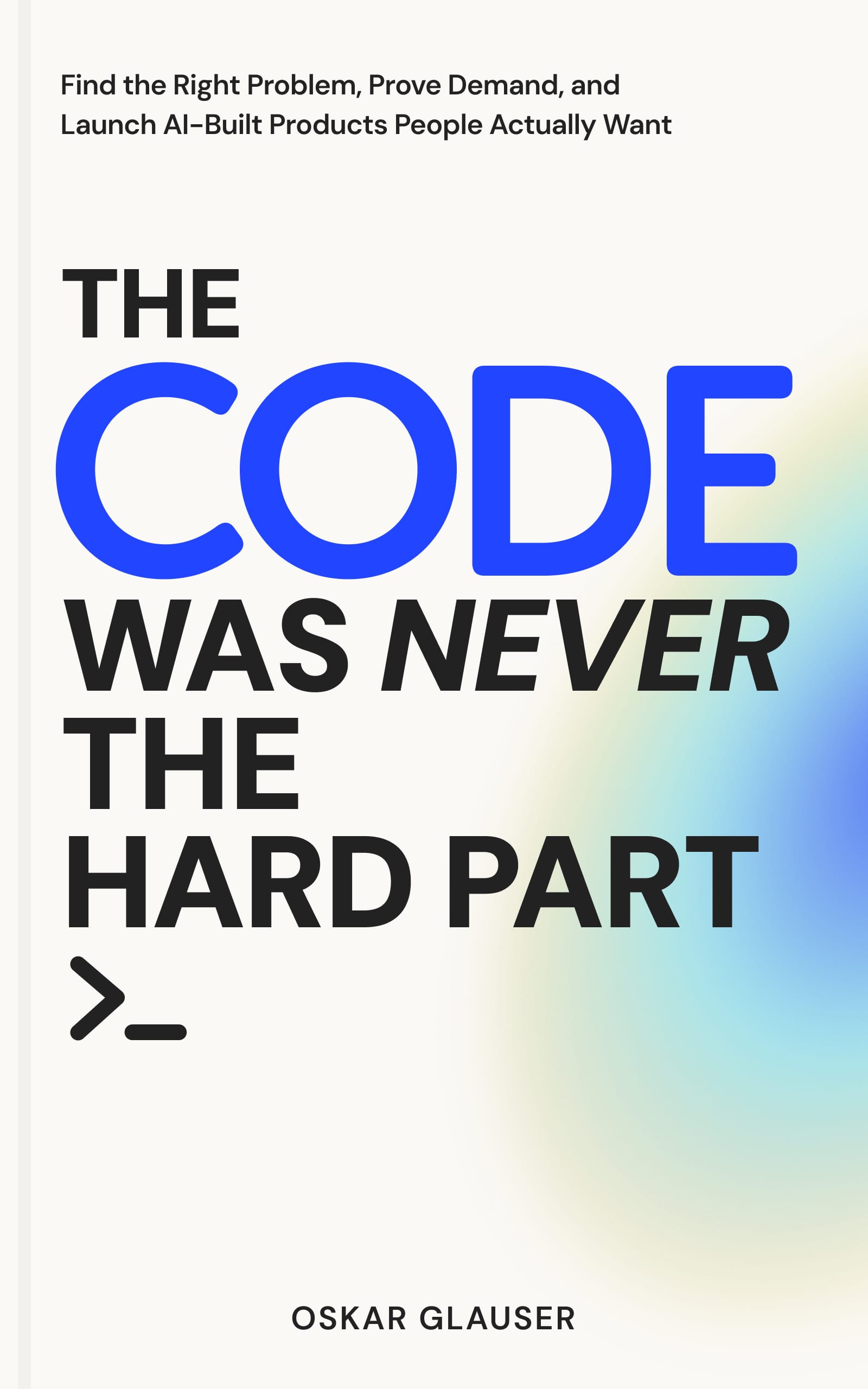
Kindle ebook · Out now
Out now. Read it this weekend.
$2.99
$9.99
launch price until 22 October
It stays $2.99 through launch week, then goes up to $9.99.
Read it on a Kindle or in the free Kindle app on your phone, tablet or computer. The paperback comes later.