The objection
In August 2026 Senko Rašić published a post called "Code was never the hard part" is an insult to all programmers. It got more than 900 points and close to 600 comments on Hacker News, so plenty of people feel the same way.
As I read him, the argument goes like this. If programming were the easy part, it wouldn't take years to learn, the interviews wouldn't be so demanding and the pay wouldn't be what it is. And if deciding what to build were the hardest job, product managers and researchers would be paid more than developers, and they aren't. People in the comments added that badly written code can sink a product whose strategy was fine, that a lot of the design gets worked out while you write the code, and that in some fields the code is plainly the hardest thing there is.
I agree with most of that. I'm a designer who has worked next to developers for twenty years, and I'm not going to tell them their job was easy.
Expensive and hard are different things
Code was slow to produce and few people could write it. Scarce things are paid well, and that explains the salaries and the interviews. It doesn't tell you what decides whether a product lives.
I co-founded Videofy, a video app that reached 500,000 users and 40 million views a month. It lost to Instagram and YouTube. The time engineering hurt us most was when we rebuilt the backend in the framework everyone was excited about that year, and the product stood still for about six months. What went wrong there was the decision to do it then.
Minutemailer went the other way. One contracted developer built the first version in a few weeks, and it was barely usable. It's still running twelve years later.
Why the title says "never"
When a product took a team and six months to build, the building took up all the attention, and we treated it as the main thing. The questions that decide the outcome were there from the start. Who is it for? What does it solve? How will people find it? Would anyone pay? They were easy to put off while there was a year of building to get through first. Now a first version can exist in a weekend, and those questions are what's left.
The kind of product the book is about
The book is for people building their first few products with AI, often next to a day job. The products are small. One workflow that removes one real pain, for a group of people you can name. It isn't about databases, game engines or the systems that keep a bank running, and nothing in it says that work was simple.
It also doesn't say you never need a developer. Someone I know has sold a Mac app for more than twenty years. This year he needed it rewritten in a newer language. He tried with AI, couldn't tell whether the result was right, and decided to work with a developer who knew the language. With twenty years of customers depending on the app, I think that was the sound call.
If you write code for a living
Your skills still count. On their own they decide less than they used to, because more people can now get a working product in front of customers. The developers I see doing well have also taken on the questions of what to build and why. Rašić ends up somewhere close to this himself. He writes that understanding users is critical to a project, and that the ideal is to know both the system and why it's being built.
If the method in the book sounds like marketing to you, read it as engineering. You state a hypothesis, test it on real people, set the thresholds before the data arrives, and stop when the numbers say stop. The conversation guide and the launch thresholds are the two places to start.
Related
- If AI can build it, what's the hard part now?, where the work moved when building got cheap
- How to validate an app idea before you build it, how to check that people want it first
- The five-question filter, five questions to run a problem through before you build
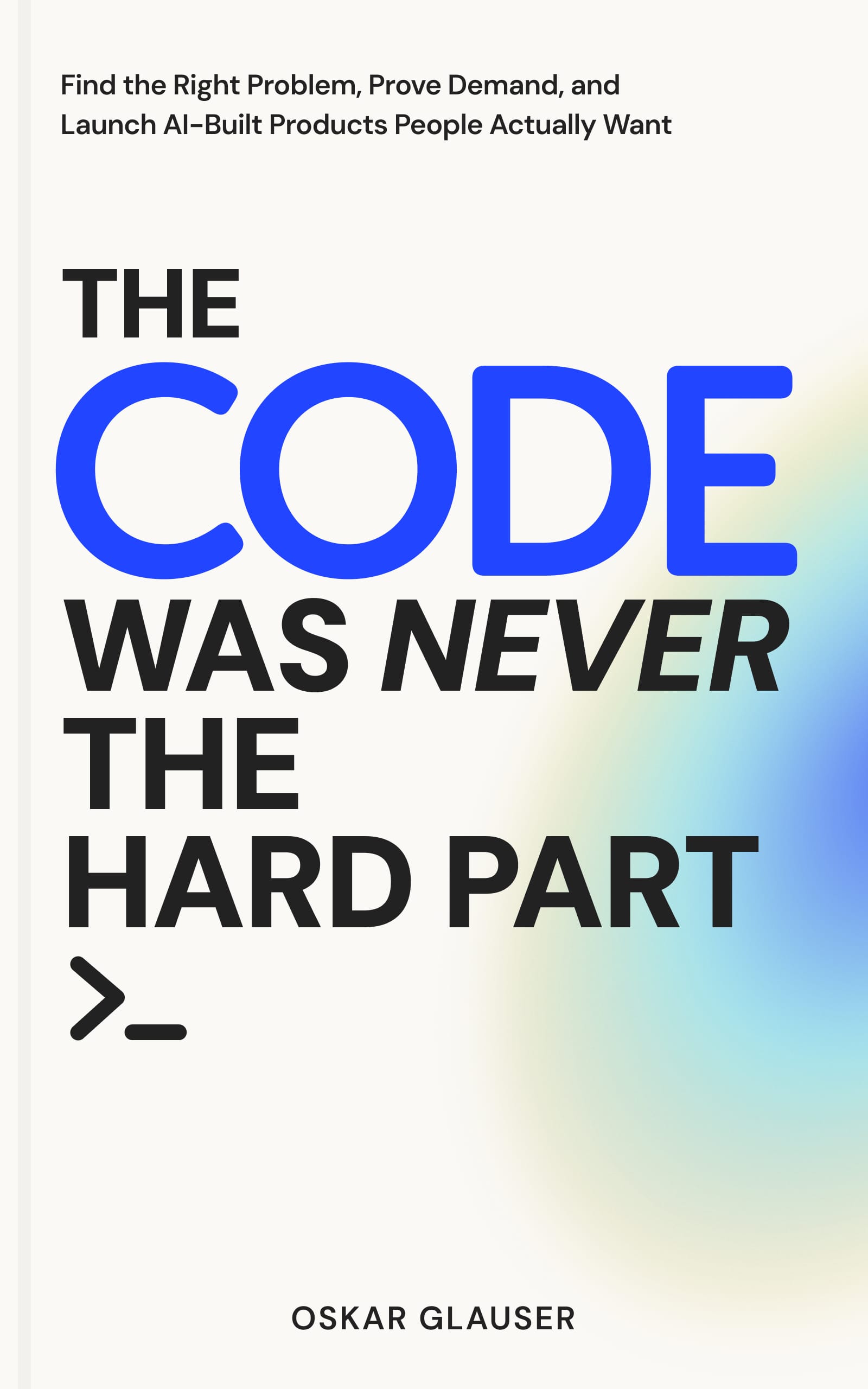
Based on chapter 1, "Anyone can build now", chapter 14, "Should you?", and appendix B, "Objections" of The Code Was Never the Hard Part.